
 English
 Русский
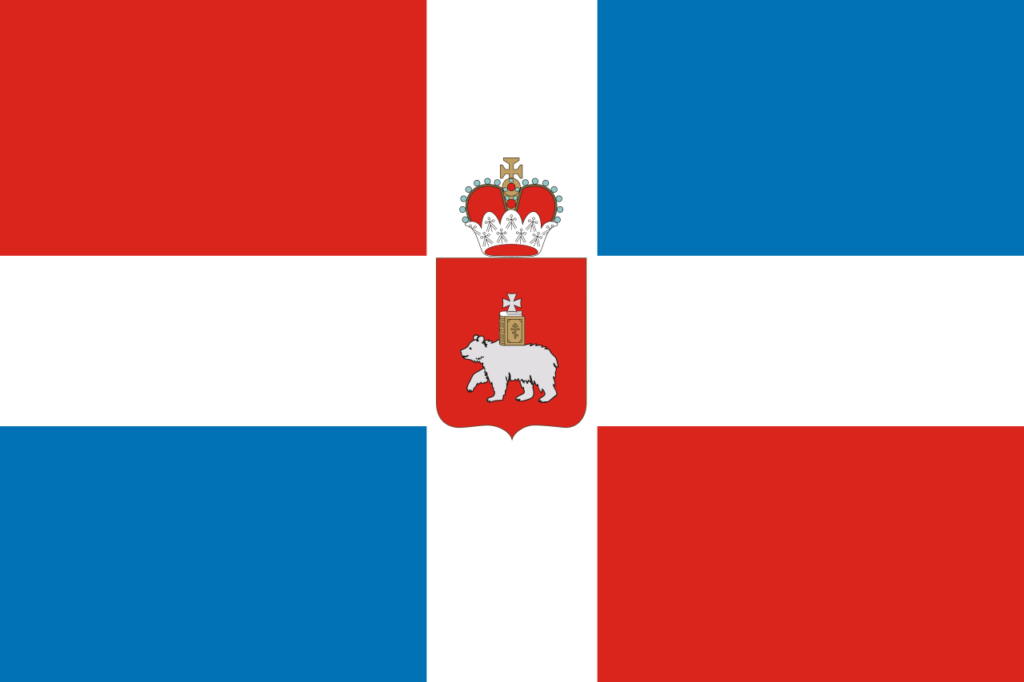
A subject of the Russian Federation located in the east of the European part of Russia. It is part of the Volga Federal District and the Ural Economic Region. The administrative center of the region is the city of Perm. The area is 160,237 km2. The population is 2,556,852 (2022). The Komi-Permyatsky District is part of the region.
It is located in the eastern part of the East European Plain and on the western slopes of the Middle and Northern Urals, in the basin of the Kama River. It borders the Komi Republic to the north, the Sverdlovsk Region to the east, Bashkortostan to the south, Udmurtia to the west, and the Kirov Region to the northwest.
It was formed on December 1, 2005 as a result of the merger of the Perm Region and the Komi-Permyak Autonomous Okrug. The historical predecessor of the region was the Perm Governorate, formed in 1796, which, in turn, was preceded by Perm Velikaya.
Administrative-territorial division: 33 administrative districts; 25 cities, of which 14 are of regional and 11 of regional significance; 26 urban-type settlements; closed administrative-territorial entity Zvezdny and Komi-Permyatsky district as an administrative-territorial unit with a special status.
History of the Perm Region
The territory of the Perm Region was inhabited by people already in the Paleolithic era (the Garchi 1 Streltsy culture site, Yelniki II, Ganichata I—II sites, Cave Log, Zaozerye, Sosnovka III, Egoshikha, etc.).
At the turn of the first and second millennia, the southern territories of modern Perm Krai came under the influence of Volga Bulgaria, and then the Mongol-Tatar yoke.
In the middle of the XV century, the Komi-Permyak medieval Grand Perm Principality (Cherdyn Principality) was formed on the Upper Kama River, dependent on the Grand Duchy of Moscow and, possibly, also from the Novgorod Republic (before 1472). Archaeologically, the principality covered the territory of the Rodanov culture. At the same time, Russian pirates appeared in the Kama region, ushkuiniki, who later became known as Cossacks. Part of the Cossacks, led by ataman Ermak, were sent by industrialists Stroganov to conquer Siberia.
After becoming part of the Russian state, the Perm lands were initially subordinated to the Solikamsk voivode, and then became part of the Siberian province, formed by Peter I on December 18 (29), 1708. When the Siberian province was divided into provinces, the Perm lands fell into the Solikamsk and Vyatka provinces. On June 4 (15), 1724, the city of Kungur with Kungur district was transferred from Vyatka province to Solikamsk. On April 29 (May 10), 1727, the Vyatka and Solikamsk provinces were transferred to the Kazan Governorate. On August 13 (24), 1737, the provincial governor was transferred from the city of Solikamsk to the city of Kungur. Solikamsk province of Kazan Province was renamed Perm Province of Kazan Province.
In 1781, by decree of Catherine II, who bore the title of “Princess of Perm”, an independent Perm governorate was formed with the division of its territory into 2 regions — Perm and Yekaterinburg. The grand opening of the viceroyalty and its center, the city of Perm, took place on October 18 (29), 1781. The viceroyalty was part of the Perm and Tobolsk Governorate-General, which was divided into Perm and Tobolsk provinces on December 12 (23), 1796.
On November 3, 1923, Perm Province was abolished, and its territory was incorporated into the Ural Region with its center in Yekaterinburg. On February 26, 1925, the Komi-Permyak National District was formed. On January 17, 1934, the Ural Region was divided into three regions (Sverdlovsk, Chelyabinsk, and Ob-Irtysh); the territories of modern Perm Krai became part of the Sverdlovsk Region. On October 3, 1938, by Decree of the Presidium of the Supreme Soviet of the USSR, the Perm Region was formed by separating it from the Sverdlovsk Region. From March 8, 1940 to October 2, 1957, it was called the Molotov Oblast.
On January 28, 1967, the Perm Region was awarded the “Order of Lenin” for the merits achieved by the region’s workers in economic and cultural construction.
In 1977, the Komi-Permyak National Okrug was renamed the Autonomous okrug. After the collapse of the USSR, with the adoption of the Constitution of Russia (1993), the district became an independent subject of the Russian Federation, however, geographically continuing to be part of the Perm Region, which is also a subject of the Russian Federation, and being in contractual relations with the region.
On December 7, 2003, a referendum was held in which residents of the Perm Region and the Komi-Permyak Autonomous Okrug supported unification into a single subject of the Russian Federation — Perm Krai. During the merger, no territorial changes were carried out, the new entity was formed on the territory of the Perm region, which geographically included the district. At the same time, the district lost its status as a subject of the Russian Federation and, accordingly, its representation in the Federal Assembly. As a result of the referendum on unification, a Federal Constitutional Law was adopted, according to which the Perm Region is considered to be formed on December 1, 2005.
Economy
Perm Krai is one of the economically developed regions of Russia. In 2018, the gross regional product amounted to 1,318,472 million rubles.
Industry
The basis of the region’s economy is a highly developed industrial complex. Key industries: petroleum, chemical and petrochemical, ferrous and non-ferrous metallurgy, mechanical engineering, timber industry.
Lukoil-Permnefteorgsintez Oil Refinery (PNOS) in Perm
About 10 million tons of oil are produced annually in the Perm Region. The leading mining company is Lukoil — Perm LLC. Oil production is concentrated in the south (Kuedinsky, Kungursky, Ordinsky, Osinsky, Chastinsky and Chernushinsky municipal districts) and the north of the region (Krasnovishersky, Solikamsky and Usolsky municipal districts).
Perm is home to large oil refining enterprises (OOO Lukoil-Permnefteorgsintez (PNOS)) and gas.
The leading branch of the chemical industry is the production of mineral fertilizers, the region accounts for 100% of the production of potash fertilizers in Russia. The world’s largest Verkhnekamskoye deposit of potash salts is located in the Perm Region. Ore mining and potash fertilizer production are carried out in Berezniki (PJSC Uralkali) and Solikamsk (PJSC Uralkali). Uralkali is one of the world’s largest producers and exporters of potash fertilizers.
The production of nitrogen fertilizers is located in Perm (JSC “Mineral Fertilizers”) and Berezniki (JSC “Azot”).
Enterprises of the petrochemical industry of the region mainly carry out primary processing of raw materials. The largest enterprises in the industry:
Sibur-Khimprom CJSC — Perm;
JSC “Metafrax” — Gubakha;
Uralorgsintez JSC — Tchaikovsky.
In addition, Perm has enterprises for the production of activated carbon (JSC Sorbent), washing powder (Henkel-Pemos), halogen-containing chemical products (JSC Halogen), and phthalic anhydride (JSC Kamtex-Khimprom).
Gubakha is home to a coke plant (Gubakhinsky Coke OJSC).
Ferrous metallurgy is represented by a full—cycle plant (JSC Chusovskaya Metallurgical Plant) and advanced metallurgy enterprises (the largest is JSC Lysvensky Metallurgical Plant).
Non-ferrous metallurgy is based on the processing of ore from the Verkhnekamskoye deposit of potash salts containing magnesium and rare metals. The plants are located in Berezniki (titanium and magnesium combine of VSMPO-Avisma Corporation) and Solikamsk (OAO Solikamsk Magnesium Plant). A plant for the production of recycled aluminum (JSC Perm Non-Ferrous Metals) operates in Perm.
The production of military products plays an important role in mechanical engineering. Perm is the largest center of mechanical engineering; aircraft and rocket engines, oil—producing and mining equipment, gasoline-powered saws, communication equipment, ships, cable and other products are produced. The largest enterprises are the Motovilikhinsky plants and the Perm Engine—building Complex.
Separate machine-building enterprises are also located in the cities of Lysva (production of turbo generators), Kungur (production of oilfield equipment), Ochera (production of drilling equipment) and Alexandrovsk (production of mining equipment), as well as the villages of Pavlovsky (Ochersky district), Suksun and Yugo-Kamsky (Perm district). The machine-building industry of the region as a whole is in a crisis state. Among the causes of the crisis, one can single out the low level of the state defense order, as well as the specialization of most enterprises in the production of components and individual parts, rather than final products, which hinders the implementation of an independent sales policy. The production of equipment for the extractive industries and railway transport is developing most successfully.
The timber industry complex of the region is based on the use of the richest forest resources of the Kama region. Logging facilities are located mainly in the north of the region. Three pulp and paper mills are located in the Perm Region: Krasnokamsk, Perm and Solikamsk (OAO Solikamskbumprom). On the territory of the region there is one of the largest enterprises of the country producing plywood — NAO “SVEZA Uralsky” (Uralsky village, Nytvensky district of Perm Krai).
Perm is the largest center of the food industry in the region. There is a meat processing plant (JSC Permsky Meat Processing Plant, part of the Prodo group), Permsky dairy plant (a branch of Unimilk), margarine, flour, distillery (JSC Permalco, part of the S.P.I. Group), wine and vodka factories (JSC Uralalco, part of the Synergy Group), two confectionery factories (Permskaya and Kamskaya owned by Nestlé), a refrigeration plant (JSC Permsky Refrigerating Plant Constellation, part of Komos Group), bakery production. Other major centers of the food industry include Kungur (meat and milk processing), Krasnokamsk (meat processing), as well as Tchaikovsky, Lysva, Kudymkar, Vereshchagino.
Museums of the Perm Region
- Perm State Art Gallery
- Perm Regional Museum
- Perm Museum of Modern Art
- Museum of “Motovilikhinsky Plants”
- Museum of the History of Perm State University
- Polenov Museum of Paleontology and Historical Geology
- Architectural and Ethnographic Museum “Khokhlovka”
- Museum of the History of Political Repression “Perm-36”
- Museum of Archeology and Ethnography of the Perm Region of the Perm State Pedagogical University
- Museum of Communications (Lysva)
- Museum of Helmets (Lysva)
- Museum of Spoons (Nytva)
- Cherdyn Museum of Local Lore
- Exhibition Hall (Cherdyn)
- Tchaikovsky Museum of Local Lore
- Museum of the History of Faith (Cherdyn)
- Museum of Cube (Gubakha)
- Museum of the History of Salt (Solikamsk)